Tampilkan postingan dengan label 21st century education. Tampilkan semua postingan

Rabu, 08 April 2015

Two Beautiful Visuals on Traditional Education System

April 9, 2015
Today we are sharing with you these two beautiful visuals we came across on Google Plus. They both capture and represent the traditional education system that is  premised on the famous motto “one size fits all”. In his book Pedagogy of The Oppressed, Paulo Freire severely criticized the ethos of this educational system that he labelled “banking system of education” and blamed it for the social and political ills that were plaguing the world at the time. More than half  a century after the publication of Freier’s classic work, nothing much has changed. The banking system is still well alive in several schools and mechanical skills are still prized over cognitive and critical thinking skills.

Concerning these visuals: We tried hard to identify their original creators through an extensive web search but in vain. Tons of websites feature them with no mention of their source. If you have any idea about their sources please let us know.

1- Education System
We learned about this visual from Emily Lewis and there is really a very good discussion around it in her page.

2- One size fits all
This graphic which we learned from Bella  features one of Albert Einstein's popular quotes "Everybody is a genius. But if you judge a fish by its ability to climb a tree, it will live its whole life believing that it is stupid".

Read more

Kamis, 19 Februari 2015

10 Must Read Books on The 21st Century Literacies

February, 2015
The literacy landscape is rapidly evolving to the extent that we can no longer expect what it will be like in the next coming years. Regardless of the nomenclature, whether you call them new literacies, emerging literacies, 21st century literacies , the traditional concept of literacy has definitely undergone so much transformations and modifications in the last two decades especially in the light of the the new technological advancements and the emergence of new forms of using and interacting with text. Literacy now entails more than just being able to decode (read) and encode (write) text, but also includes the ability to express and communicate through a multimodal system of signs, the ability to analyze, evaluate, synthesize, critically appraise and share different forms of information.


For those of you interested in delving deep into the concept of new literacies, the academic works below are definitely a must read. These books will help you understand the essence of 21st century  literacies and enable you to conceptualize a working definition of what they mean in an academic context.

1- New Literacies: Everyday Practices and Social Learning  . By Colin Lankshear and Michele Knobel

2- The New Literacies: Multiple Perspectives on Research and Practice. By Elizabeth A. Baker EdD (Editor), Donald J. Leu (Foreword)

3- A New Literacies Reader: Educational Perspectives (New Literacies and Digital Epistemologies). By Colin Lankshear (Editor), Michele Knobel (Editor).

4- What School Leaders Need to Know About Digital Technologies and Social Media. By Scott McLeod (Editor), Chris Lehmann (Editor), David F. Warlick (Foreword)

5- Literacy in the New Media Age (Literacies). By Gunther Kress (Author)

6- Teaching with the Internet K-12: New Literacies for New Times. Donald J. Leu Jr. , Deborah Diadiun Leu , and  Julie Coiro.

7- Confronting the Challenges of Participatory Culture: Media Education for the 21st Century. By Henry Jenkins (Author), Ravi Purushotma (Contributor), Margaret Weigel (Contributor), Katie Clinton (Contributor), Alice J. Robison (Contributor)

8- Handbook of Research on New Literacies. By Julie Coiro (Editor), Michele Knobel (Editor), Colin Lankshear (Editor), Donald J. Leu (Editor)

9- New Literacies In Action: Teaching And Learning In Multiple Media. By William Kist (Author)

10-  The Anti-Education Era: Creating Smarter Students through Digital Learning. By James Paul Gee


 Follow us on : Twitter, Facebook , Google plus, Pinterest .
Read more

Selasa, 17 Februari 2015

5 Effective Ways for Developing Problem Solving Skills

February 17, 2015
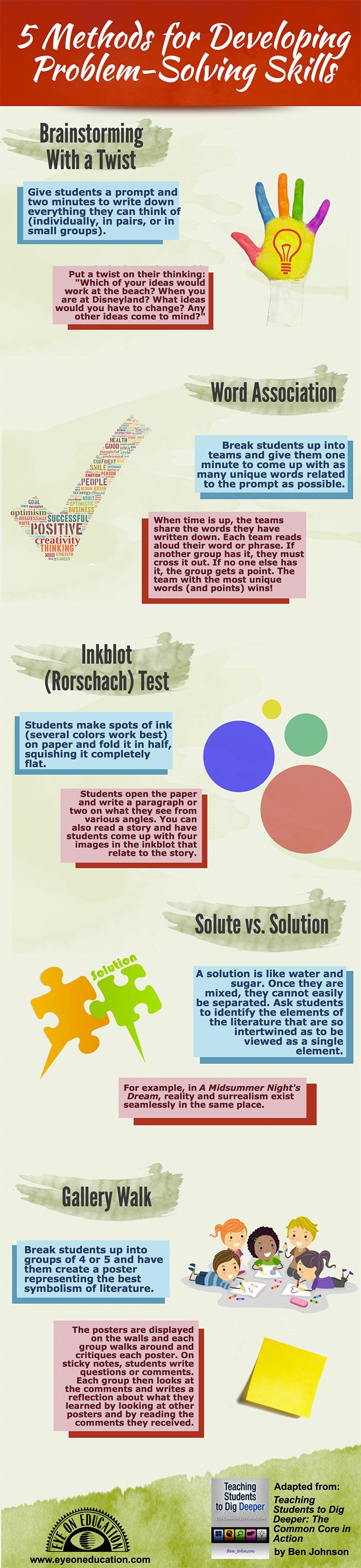
Here is a wonderful visual from Eye on Education featuring 5 methods for developing problem-solving skills. This work is adapted from Ben Johnson’s book “ Teaching Students to Dig Deeper; The Common Core in Action”. The methods advocated here include: brainstorming, word association, Inkblot test, solute vs solution, gallery walk. Each of these methods is explained and illustrated with examples on how to use it with your students. I invite you to check it out and share with us what you think of it . Enjoy

Problem solving strategies
Read more

Rabu, 04 Februari 2015

Awesome Chart Comparing Traditional Versus 21st Century Learning

February 4, 2015
In his classic book “Education and Experience” John Dewey talks about the dichotomy between traditional and progressive forms of education saying that such a dichotomy polarizes discussions around educational matters. Dewey, instead,  argued for an experience-based model that builds on the drawbacks and strengths of both models to form a holistic conceptualization of what a student-centred education should be like. Today, as I stumbled upon this beautiful chart on Mindhsift’s Facebook page I could not help but connect it to Dewey’s discussion of experiential and progressive learning. What in the chart is labelled 21st century learner is in fact the kind of learner Dewey theorized in his work more than half  a century ago. Therefore, the ethos are not new but the circumstances are different.

In my view, dichotomizing traditional and 21st century learning does not necessarily favour the latter over the earlier though 21st century model of learning is what is expected in our classes but more importantly it raises educators critical awareness of the affordances and of inconveniences of each model  in the hope of constructing a robust model that meets the learning needs of individual students.

This chart is created by Like to Write  which has two interesting resources: liketowrite.com and liketoread.com .


Read more

Kamis, 29 Januari 2015

A Very Good Checklist for Assessing 21st Century Learning Skills

January 29, 2015
Here is another great resource from Dr. Jackie Gerstein, one of our favourite EdTech bloggers. Jackie designed this beautiful chart featuring  12  attributes and skills that teachers should tend to in their instruction. You can use it as a self-assessment checklist to help you evaluate your teaching practice.

What  I like the most about this chart is the fact that it emphasizes the social and affective component in learning, something which is often overlooked in today’s digitally-focused learning paradigms. These mechanical skill-based and market-oriented paradigms reduce students to ‘cheerful robots’ and view pedagogy as ‘merely a skill, technique, or disinterested method’ to teach pre specified subject matter' (Giroux, 2011). Instead, education should be viewed as an important locomotive not only for gainful employment but also for ‘creating the formative culture of beliefs, practices, and social relations that enable individuals to wield power, learn how to govern, and nurture a democratic society that takes equality, justice, shared values, and freedom seriously.(Kindle Location, 67 from "On Critical Pedagogy").

Jackie's set of attributes featured in this chart chime in with Giroux's view of education as a way of producing citizens who are 'critical, self-reflective, knowledgeable and willing to make moral judgements and act in a socially responsible way.'

Check out Jackie's original post to access more resources and links accompanied with this chart.


Read more

Minggu, 25 Januari 2015

16 Habits of Mind Essential for 21st Century Learners

January 25, 2015
Below are 16 habits of mind our students need to develop in order to guarantee an optimal learning experience. These are cognitive processes that work at an analytic level to enhance one's mental and conceptual capacities in  analysing and understanding things. Different as they are, these mind habits when taken together constitute the essence of a growth mindset needed for a balanced intellectual, social and physical development of the individual.

The 16 habits of mind is a work realized by Habitsofmind.org which is a very good platform that provides a wide variety of teaching materials and resources for teachers and educators. The chart  is not really visually enhanced and I found it hard to peruse it so I went ahead and prepared this paraphrased  script for you.


1- Persisting:
Persevere in you what you do and keep focused. It took Thomas Edison over 10.000 failed attempts to finally reach his breakthrough invention.

2- Managing impulsivity
Take your time and think before you act. Keep thoughtful and deliberative

3- Listening with empathy
Make an effort to understand others’ ideas and points of views.

4- Thinking flexibly
Be flexible with your thoughts and be ready to try different alternatives and options.

5- Thinking about your thinking (metacognition)
Be aware of your own thinking processes and the  impact they have  on your action and behaviour.

6- Striving for accuracy
Do your best to get it right and keep looking for ways to improve for the best.

7-Questioning and problem solving
Adopt a questioning and inquisitive mindset. Nothing is taken for granted and questions are the key to a better understanding.

8- Applying past knowledge to new situations
Draw on your prior knowledge to enhance your present learning experiences. Maintain a connection between your past knowledge and your actual learning.

9-Thinking and communicating with clarity and precision
Be clear in your communication and avoid things that would complicate the clarity of your message such as over-generalizations, exaggerations, and distortions.

10- Gather data through all senses
Use all your senses to collect data. Observe the world around you and draw on your senses to explore it.

11- Creating, imagining and innovating
Be creative and imaginative in your thinking. Look for new untrodden paths and explore novel possibilities.

12- Responding with wonderment and awe
Enjoy your learning and have fun learning more.

13- Taking responsible risks
Be adventuresome and try new things constantly.

14- Finding humour
Be humorous and give vent to the whimsical inside you.

15- Thinking interdependently
Develop team work skills and know how to work collaboratively with others.

16- Remaining open to continuous learning
Never stop learning. Learning is a life-long journey and you need to take it till the end.

Read more

Minggu, 11 Januari 2015

A Beautiful Illustration of The Impact of Technology on Education

January 12, 2015
Technology is radically transforming the educational landscape giving rise to new forms of learning and teaching and empowering students with a variety of tools and apps to enhance their learning. And while problems related to both technicality and resources are still holding back several school districts from tapping fully into the potential of digitality, programs such as 1:1 and BYOD (Bring Your Own Device) seem to prove a flicker of hope in the horizon.

The transformational power of technology and its far-reaching impact on the field of education is the topic of a video I discovered today through Emerging EdTech and decided to share it with you below. The video, which is realized by Curriculum Associates,  provides a very good “discussion of the rapidly changing world of education technology and the great potential it has to transform how teachers teach and students learn. Enjoy


Read more

Sabtu, 10 Januari 2015

The 6 Major Skills for 21st Century Students

January, 2015
Here is a short two pages PDF document from ISTE (International Society for Technology in Education) which features the six major fluencies (standards) students need to develop in the 21st century classroom. Each of these fluencies is broken down into various skills all of which work in unison to cultivate the target fluency. From all the resources I have shared here on the 21st century teaching and learning, this document is by far the most comprehensive and practical. It touches on almost all the skills and competencies required to build an intellectually, socially, culturally, and digitally apt student. Here is a quick round-up of the six major fluencies included and you can access and download the the full document from this LINK.


1 - Creativity and innovation
“Students demonstrate creative thinking, construct knowledge, and develop innovative products and processes using technology”

2- Communication and collaboration
“Students use digital media and environments to communicate and work collaboratively, including at a distance, to support individual learning and contribute to the learning of others”.

3- Research and Information fluency
“Students apply digital tools to gather, evaluate, and use information.”

4- Critical thinking, problem solving, and decision making
“Students use critical thinking skills to plan and conduct research, manage projects, solve problems, and make informed decisions using appropriate digital tools and resources”

5- Digital citizenship
“Students understand human, cultural, and societal issues related to technology and practice legal and ethical behavior.”

6- Technology operations and concepts
“Students demonstrate a sound understanding of technology concepts, systems, and operations.”

Follow us on : Twitter, Facebook , Google plus, Pinterest .
Read more

Rabu, 07 Januari 2015

The Top 10 Trends That Will Affect Learning in 2015

January 7, 2015
In a rapidly changing educational landscape, learning trends are constantly emerging and reshaping the century-old notions of teaching and learning. Digitality is absolutely a key factor in these new changes but there are also other factors that have their part in what’s going on now in education. Educational Stakeholders are convinced more than anytime before that change is an inevitable feat and that the traditional content and performance based pedagogic strategies are to be replaced with more robust concepts that can speak to the ethos and demands of the new era.

Source: http://goo.gl/k6lXLa

The folks in Personalized Learning have put together this wonderful visual featuring the 10 trends that will influence learning in 2015. These trends are encompassed in four major concepts: learning culture, learning environments, deeper learning, and partners in learning. I invite you to read this great article explaining these various trends and share with us what you think of them. This article is also available in the form of infographic from this LINK.

Read more

Jumat, 02 Januari 2015

11 Traits of Effective Teachers

January 2, 2015
 I am not sure if you have already read it or not but this is one of the most popular posts by Edutopia in 2014."11 Habits of An Effective Teacher" is written by Carrie Lam (an academic director in Canada) in which she talked about some important traits that distinguish effective teachers. From the 11 features she mentioned the ones that resonated with me the most are open-mindedness and embracing change. To me these are the foundational attitudes underlying a successful teaching career.

Source: Edutopia's Facebook Page

An open minded teacher is a person who learns from his/her failures and regards criticism as constructive and integral to their professional development.The corollary of this attitude are things such as reflection and inspiration. To learn from negative experience or from criticism does perforce entail reflecting on the initial reasons that led to such an experience. The same with embracing change. In a rapidly evolving educational landscape, teachers need to adopt a growth mindset, one that allows them, in Darwinian terms, to easily adapt to the new circumstances without getting stuck in ruts and grooves.

Check out  Carrie's full article  to explore all the 11 habits of effective teachers . Enjoy

Read more

Selasa, 30 Desember 2014

The 18 Skills Every 21st Century Learner Should Develop

December 30, 2014
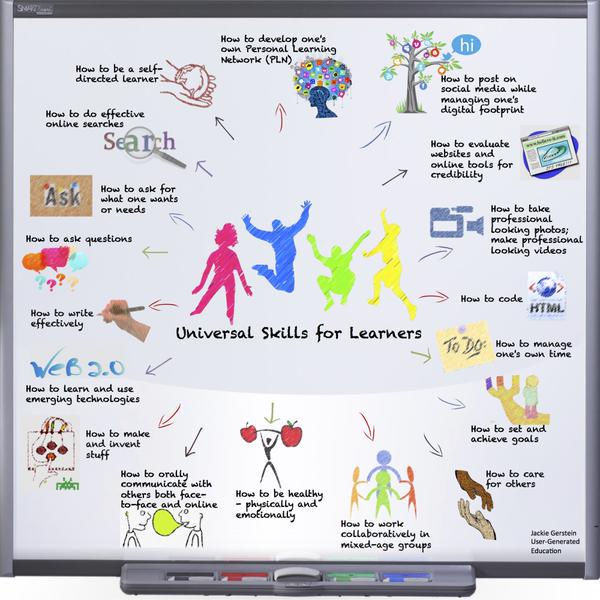
Here is another great visual from Dr Jackie Gerstein featuring a set of some important universal skills for learners. Personally, I prefer to view them from a competency based lens and consider them as competencies that lead up to the development of the required skills. But regardless of the theoretical stance underlying your view, these competencies/skills are the key drivers of learning in a multimodal and multimedia environment. From time management to how to ask effective questions, the insights included in this visual are definitely something you would to have a look at.
Thanks to Reid Wilson through whom I learned about this resource.

For more details and resources related to this visual, I recommend that you check Jackie's post "Universal Skills All Learners should Know how to Do". It is really a great read.


Universal skills for learners


Read more

These Are The 16 Attributes of The Modern Educator

December 30, 2014
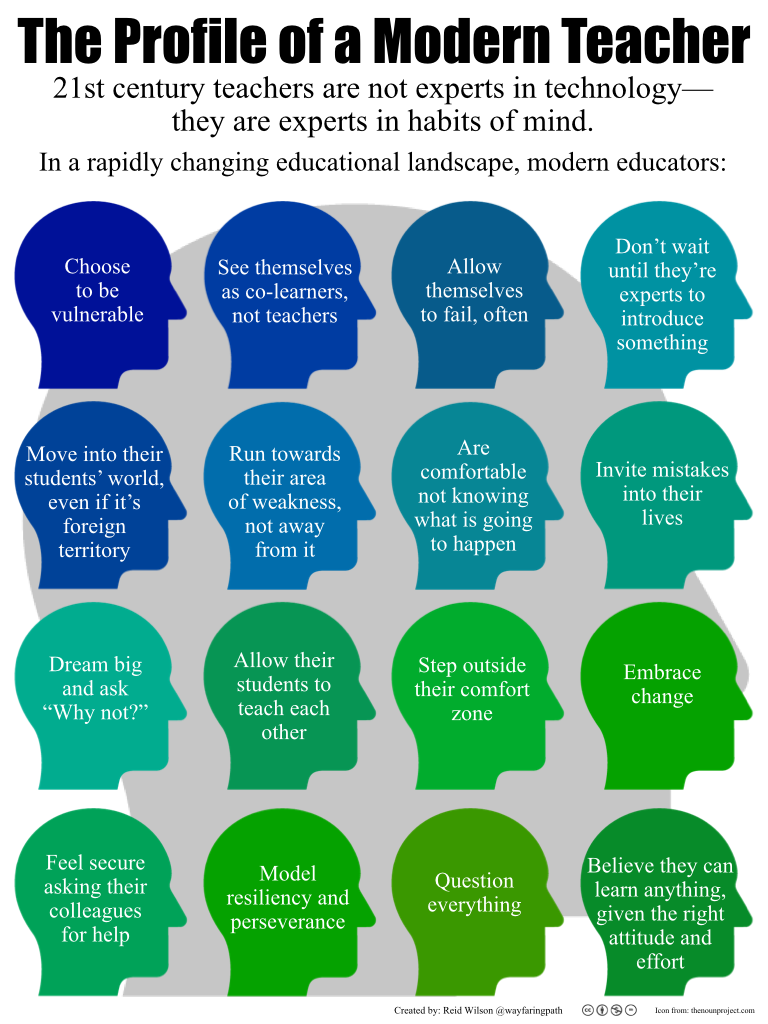
As teachers and educators, we are constantly required to review, evaluate and renew our teaching strategies to align them with  the cultural, technological and pedagogical ethos of the era we are living in. In today's era, the digital component is at the foreground which obviously calls for a new mindset, a novel conceptual framework that views technology not as an end itself but solely a mean to an educational end. It is a truism that digitality has opened a new horizon of unprecedented learning opportunities and experiences  but we can only tap into its full educational potential when we equip ourselves with the proper mindset: a growth and open mindset that as much as it adapts it also disrupts the century-old orthodoxies underlying teaching and learning practice. Teaching is a dynamic concept which is constantly evolving and expanding and that is why teachers and educators are forever learners.

Engaging in such a life-long learning journey entails that teachers develop a set of robust thinking habits that allow them to fit in the rapidly evolving educational landscape.These habits are, according to Reid Wilson, what make the profile of a modern educator. Below is an awesome visual created by Wilson featuring some of the characteristics of a modern teacher which I want to bring to your attention. Have a look and share with us what you think of it. Enjoy


Characteristics of the modern educator

Read more

Jumat, 12 Desember 2014

10 Things You Can Not Do in A 21st Century Classroom

December 12, 2014
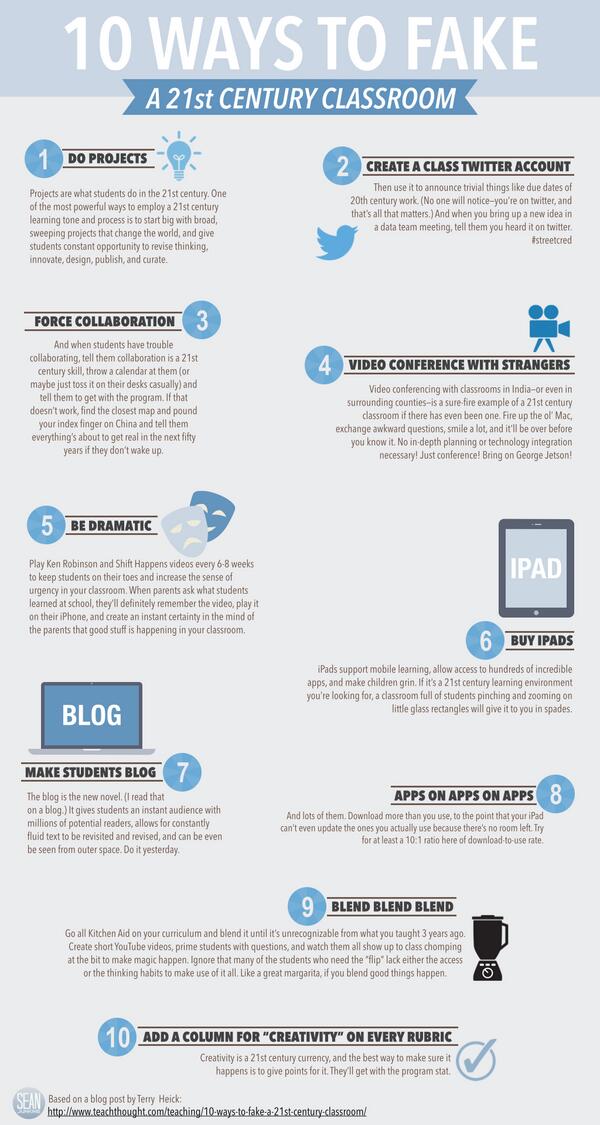
One way to better understand the concept of a 21st century classroom is through exploring what it is not. Unlike the numerous resources we have shared here on the defining features of a 21st century classroom, today I am sharing something different. This is a visual  realized by Sean Junkins based on an article from Teachthought. The  visual  features ten ways to fake a 21st century classroom. I paraphrased and summarized them for you below. While I really like this work, I do, however, have some reserve on ideas in number 6 and 7. I don't think they are properly articulated in the visual. But still the gist behind the work is well communicated. Have a look and share with us what you think of it.

1- Do Projects
Start your year with assigning students big world-changing projects to work on.

2- Create a class Twitter account
Create a Twitter account and start sharing trivial and mundane links on it.

3-Force collaboration
Push students to contrive collaborative work.

4- Video conferencing with strangers
Use unplanned, unprepared and random video conference sessions with no relevance to what you teach and what your students learn.

5-Be dramatic
Make parents believe that students are learning by repeatedly playing videos such as Ken Robinson and Shift Happens and creating a heightened sense of urgency in class.

6- Buy iPads
'Get iPads to a classroom full of students pinching and zooming on little glass rectangles.'

7-Make students blog
Force students to blog

8- Apps on apps on apps
Download as many apps as you can till your iPad's storage capacity is used up.

9-Blend, blend, blend
Blend whatever the cost and no matter whether students have access or the thinking habits to deal with flipped instruction.

10- Add a column for "creativity" on every rubric
'Creativity is a 21st century currency, and the best way to make sure it happens is to give points for it.'

10 ways to fake 21st century classroom

Read more

Senin, 08 Desember 2014

The Digital Learning Wheel

December, 2014
Ring of Technologies is a beautiful visual wheel that displays a host of learning goals together with some examples of web tools to achieve them. To me this work  (created and shared by UAF eLearning Faculty Resources) represents the core of digitally-based learning. It also chimes in with what we have said about purposeful use of technology in instruction. Having clear goals about what you want to target in your teaching using technology will definitely help your learners make the best of that technology.
Here is an example of one of the readings of the different components of the wheel. For instance as a teacher keen on enhancing my professional development (goal), I can make use of social bookmarking websites or blogging platforms (tools ) to reach my purpose. Check out the other goals and web tools mentioned in this wheel and share with us what you think of it.

This wheel is also available for free download in PDF format from this link.

Read more

Minggu, 07 Desember 2014

These Are The 4 Concepts Shaping 21st Century Learning

December, 2014
Today's learning landscape is enriched with a variety of new concepts that were to the recent past foreign  to many. Of course learning is a dynamic field and it will always keep developing as human knowledge progresses. But the last two to three decades in particular have witnessed the outburst of several new conceptions and theoretical frameworks that, among other things, attempt to capture the latest developments in learning . This cheat sheet features a number of these concepts.

I am also sharing with you the visual below which highlights three more concepts shaping the 21st century learning. To these I added the concept of Andragogy.

Source: http://goo.gl/MBwZfp

1- Andragogy
Andragogy is a teaching strategy developed for adult learners. Andragogy has been around for more than a century but it gained more momentum and came up to the surface in educational literature particularly with the work of Malcom Knowles. Andragogy marks a clear departure from the traditional pedagogy informing child learning in that it is predicated upon 5 assumptions related to the characterstics of adult learners :

  • 1. Self-concept: As a person matures his self concept moves from one of being a dependent personality toward one of being a self-directed human being
  • 2. Experience: As a person matures he accumulates a growing reservoir of experience that becomes an increasing resource for learning.
  • 3. Readiness to learn. As a person matures his readiness to learn becomes oriented increasingly to the developmental tasks of his social roles.
  • 4. Orientation to learning. As a person matures his time perspective changes from one of postponed application of knowledge to immediacy of application, and accordingly his orientation toward learning shifts from one of subject-centeredness to one of problem centredness.
  • 5. Motivation to learn: As a person matures the motivation to learn is internal (Knowles 1984:12)

Check out this page to learn more about Andragogy: 

                                        Related : Pedagogy Vs Andragogy

2-Heutagogy
Heutagogy is the study of self-directed learning and self- determined learning. While some think about Heutagogy as a separate methodology from Andragogy, several other scholars view it as an extension of Andragogy. Heutagogy is all about teaching learners how to learn. In this respect,  "heutagogy looks to the future in which knowing how to learn will be a fundamental skill given the pace of innovation and the changing structure of communities and workplaces.”
Here is a PDF document to learn more about Heutagogy.

3- Peeragogy
As for peeragogy, here are some definitions cited by Arenastudies:
“Peeragogy (which he refers to as “paragogy”), is a collection of “the best practices of effective peer learning.”
“It is also a theory of peer-to-peer learning and teaching that addresses the challenge of peer-producing a useful and supportive context for self-directed learning”.Charles Jeffrey Danoff .

Check out this post to learn more about Peeragogy.

4- Cybergogy
This is a completely novel concept to me and as I searched further on its meaning I came across this entry from Edutech Wiki:
One of the central elements of cybergogy is the intent to combine fundamentals of both pedagogy and andragogy to arrive at a new approach to learning (Carrier & Moulds, 2003). Cybergogy focuses on helping adults and young people to learn by facilitating and technologically enabling learner-centered autonomous and collaborative learning in a virtual environment. At the core of cybergogy is awareness that strategies used for face-to-face learning may not be the same used in the virtual environment.

Read more

Jumat, 28 November 2014

Things 21st Century Teachers Should Be Able to Do

November 29, 2014
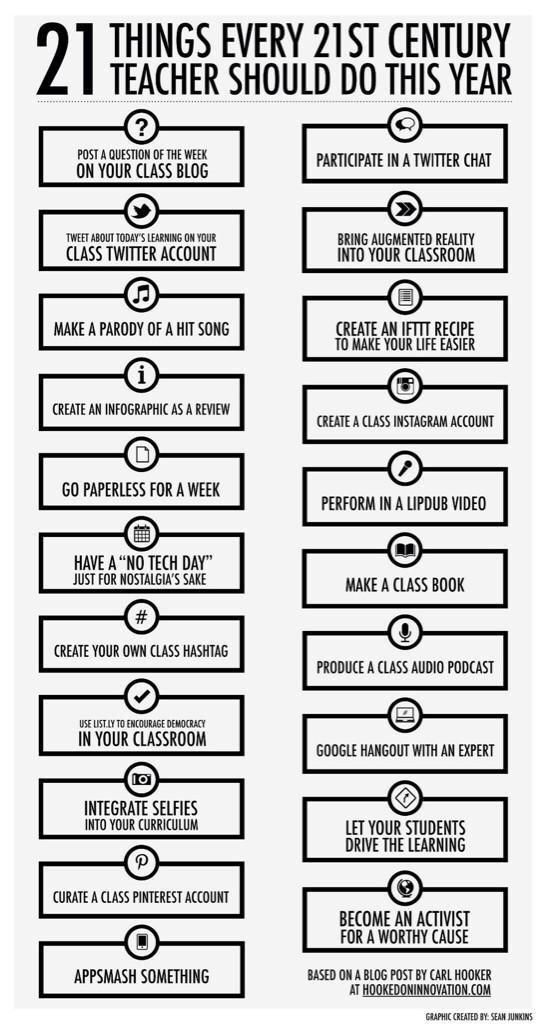
Today as I was wading through my bookmarks I came across this resource which I have saved awhile ago. This is a chart featuring what its author called 21 things every 21st century teacher should do this year. This chart is created by Sean Junkins based on a blog post by Carl Hooker. I went through the ideas suggested here and thought of providing you with some good web tools to apply to some of these ideas. The tools I am sharing are based on posts I have published in this blog.

Make sure you read Carl's original article for more details on each of the 21 ideas featured in the visual below.

1- Post a question of the week on your classroom blog
Here is a set of useful web tools and iPad apps that you can use to create a class blog if you haven't already created one.

2-Participate in a Twitter chat
You can check this comprehensive list of educational Twitter chats and select the ones you want to participate in.

3- Create your own class hashtag
Here is a good guide to help you better understand the concept of hashtags and how you can use them in your instruction.

5- Create an infographic as a preview
Here are some good tools to help you create infographics.

6- Make a class book
These are some of the tools and apps you can use to create a class book.

7- Google hangout with an expert
Here is a guide to help you understand how to organize and join Hangouts.

8- Bring augmented reality into your classroom
Here is a collection of some useful  apps for augmented reality.


21 Things Every 21st Century Should Do This Year
Read more

Jumat, 31 Oktober 2014

The 8 Components of A Digital Learning Environment

November 1, 2014
Another great read but this time from BYOT Network. In this paper entitled " The Components of a Digital Age Learning Ecosystem", Dr Tim Clark suggests 8 elements as being constitutive of a digital learning environment. And though I have some remarks on the use of the term ecosystem as being too complex a term for capturing the learning intricacies that take place in a learning environment I would rather disregard this comment and focus more on the 8 elements the article features . These elements are :

Source of the image: http://goo.gl/lnvVAB


1- A sense of community
2- Essential questions
3- Captivating digital content
4- Assessment for learning
5- Multiple teaching tools
6- Designs for differentiation and accessibility
7- Supportive classroom environment
8- Engaging instructional strategies

Here is my take on the first two elements and I invite you to check the original article to learn more about all the 8 components of a digital age learning ecosystem and share with us what you think of them.

The first element is "a sense of community". This is probably the equivalent of Lave and Wenger's communities of practice. At the core of it is the idea of  enhancing the spirit of collaboration in class and transforming the traditional roles of teachers from experts to facilitators and explorers.
The second element is "essential questions". This one aims at constructing an inquiry-based instructional strategy in class where students get to formulate and develop their learning experiences with the help of thought provoking questions.

Read more

Rabu, 29 Oktober 2014

The 5 Main Fluencies of The 21st Century Learning

October 29, 2014
Today I want to share with you this awesome read I came across in Global Citizen Education. The article is entitled " 21st Century Fluencies" and is basically based on Crockett et al.'s book Literacy is Not Enough. The main argument in this paper is that 21st century fluencies are process skills that students need in order to thrive in a rapidly changing world. These process skills include things such critical thinking, problem solving, creativity, and innovation to mention but a few. "The 21st century fluencies", as the authors of this work state, "are not about hardware, they are about headware and heartware".


Image source: http://goo.gl/GJKHzD

The article talks at length about five main fluencies. Here is a brief overview of each of these fluencies and you can check the original article for more  in-depth analysis of each of these fluencies.

1- Solution Fluency
" Solution Fluency is the ability to think creatively to solve problems in real time by clearly defining the problem, designing an appropriate solution, delivering the solution and then evaluating the process and the outcome."

2-Creativity Fluency
Creative Fluency is the process by which artistic proficiency adds meaning through design, art, and storytelling. It is about using innovative design to add value to the function of a product though its form

"Collaboration Fluency is team working proficiency that has reached the unconscious ability to work cooperatively with virtual and real partners in an online environment to solve problems and create original products".

" There are two components of Media Fluency. Firstly, the ability to look analytically at any communication to interpret the real message, and evaluate the efficacy of the chosen medium. Secondly, to create original communications by aligning the message and audience though the most appropriate and effective medium."

Information Fluency is the ability to unconsciously and intuitively interpret information in all forms and formats in order to extract the essential knowledge, authenticate it, and perceive its meaning and significance.

Read more